AI-assisted development breaks the old lifecycle: a model's output can be wrong in ways a test never sees. So a feature needs a human review at every point where a model's work enters the product, and it needs a definition sharp enough that every later gate can check against it.
Seven gates, and the skill at the first one
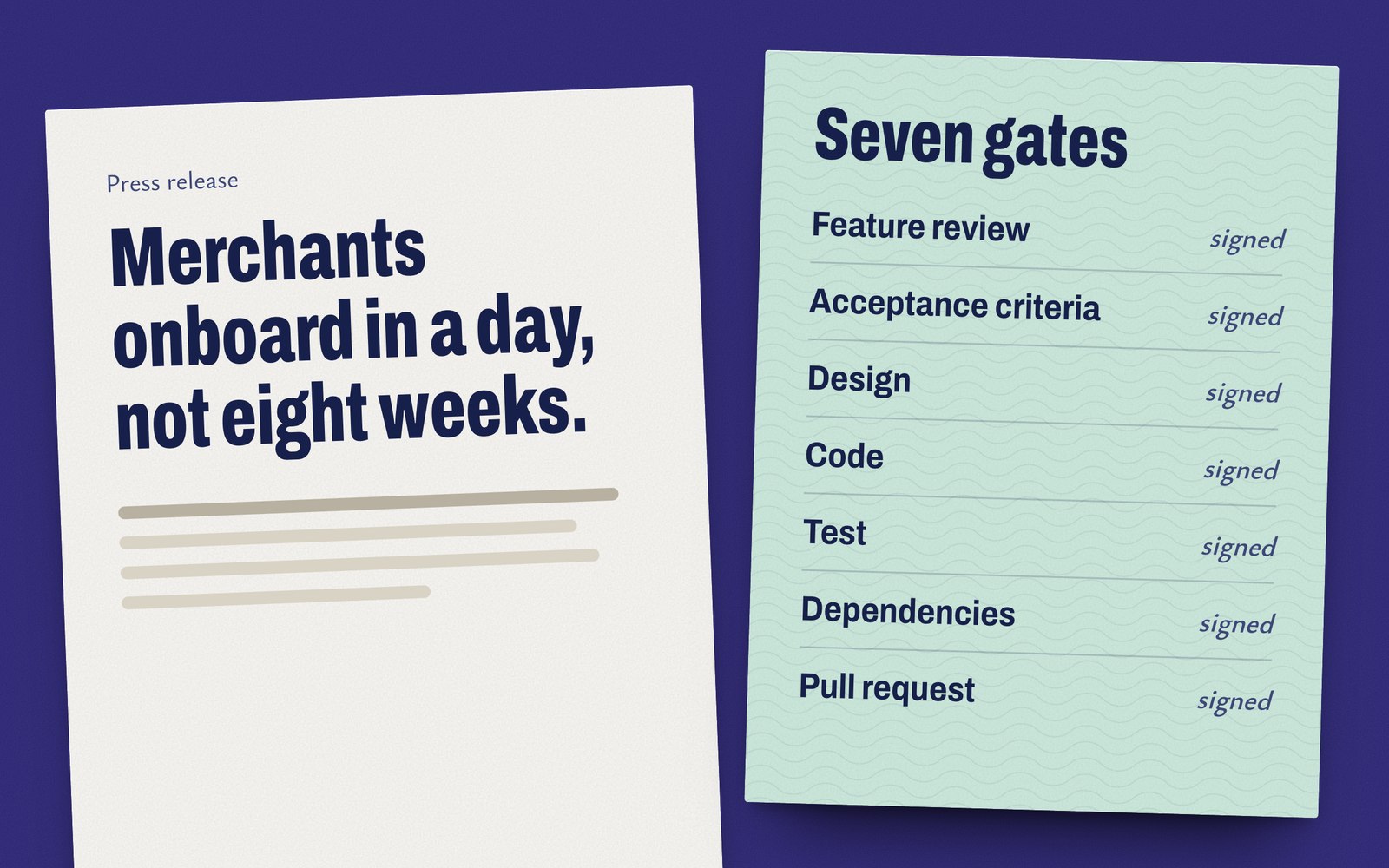
Gate 1, feature review, and gate 2, acceptance criteria were mine. I ran Working Backwards sessions to turn a fuzzy problem into a press release, FAQs and requirements that each cite the customer narrative they came from. On one network-onboarding feature that produced 104 acceptance criteria across about 20 areas.
Gates 3 to 7: design, code, test, dependencies, pull requests, owned by engineering, each ending in a named reviewer signing off on what the AI produced.
The rollout. The framework came from engineering leadership; I led my team's adoption, proved it on a feature that took network onboarding from 8 weeks to 1 day, and ran the enablement that took it to 50+ product managers.
The skill, rebuilt in the open
On my own time I rebuilt the Working Backwards part as an open-source Claude Skill: nine gated stages from press release to engineer-ready requirements and a tracker import, with a separate judge reviewing every stage. Its evals are published, misses included: the judge agrees with human labels on 14 of 14 cases, and the author prompts pass 25 of 26 contract properties.
What I would flag
Every gate ends in a person. The speed is a by-product; the point is that nothing AI-generated reaches production without a named reviewer.
The open-source skill is my own re-creation of the method, with fictional worked examples. Nothing employer-internal is in it.