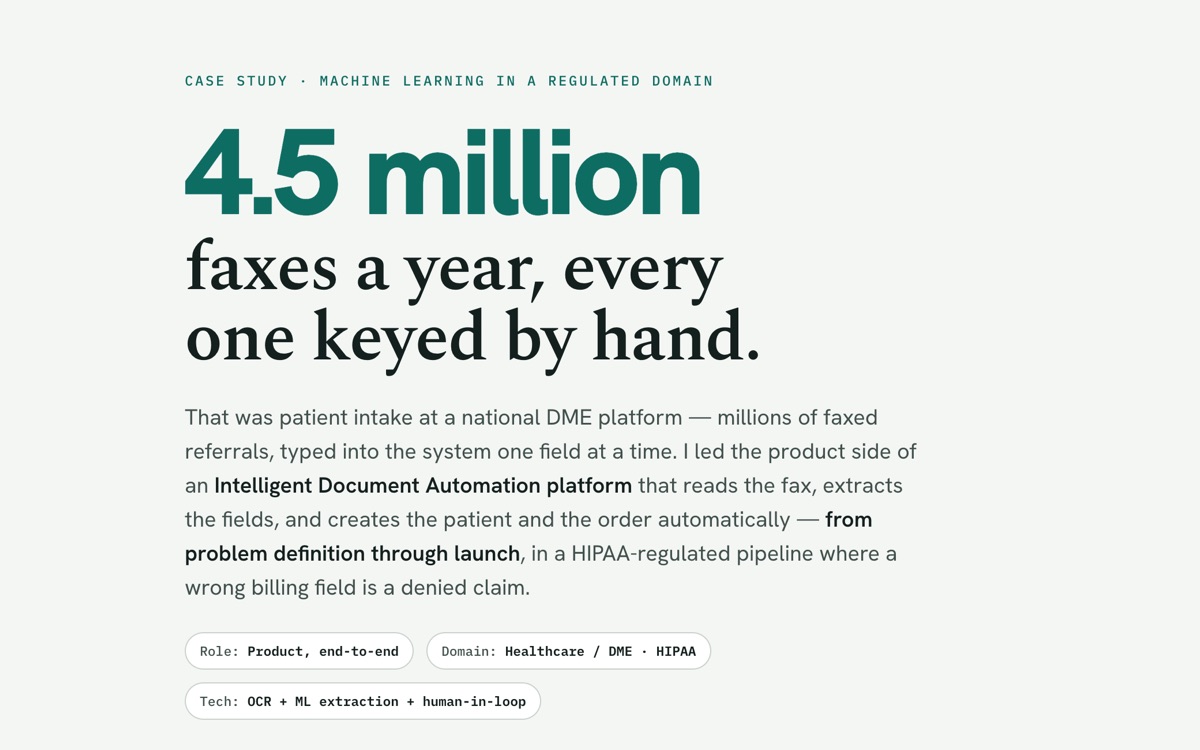
About 4.5 million faxes a year arrived at a healthcare equipment platform, and staff keyed every one in by hand to start a patient and bill an order. Each patient took about 30 minutes of admin time. In this setting a wrong billing field is not a typo. It is a denied claim.
What I owned
The data scientists built and trained the model. I owned everything that decided whether the model became a product.
What gets read. The document types and fields, starting with the ones that open a patient and bill an order.
Where a person steps in. A confidence threshold sends anything uncertain to a reviewer before it becomes a record.
What good enough means. The accuracy bar for launch, the automation rate and the time saved, tracked every release.
Compliance as a launch gate. Patient data protected and every access audited. I set the requirement; engineering built the controls.
The trade-off. Accuracy over automation. A missed automation costs a person a few minutes. A wrong field costs a customer their revenue.
Proof
Intake time per patient30 min to 5
Field-level extraction accuracy~95%
Claim denials from bad intake data10% to 1%
What I would flag
The figures are the ones measured at launch, and the savings estimate rests on stated assumptions about admin time and cost.
95% at field level was not good enough to auto-submit billing fields blind. That is why the threshold and the reviewer exist.
Automation rate and error rate pull against each other. The error rate on auto-processed documents is the number that keeps the threshold honest.